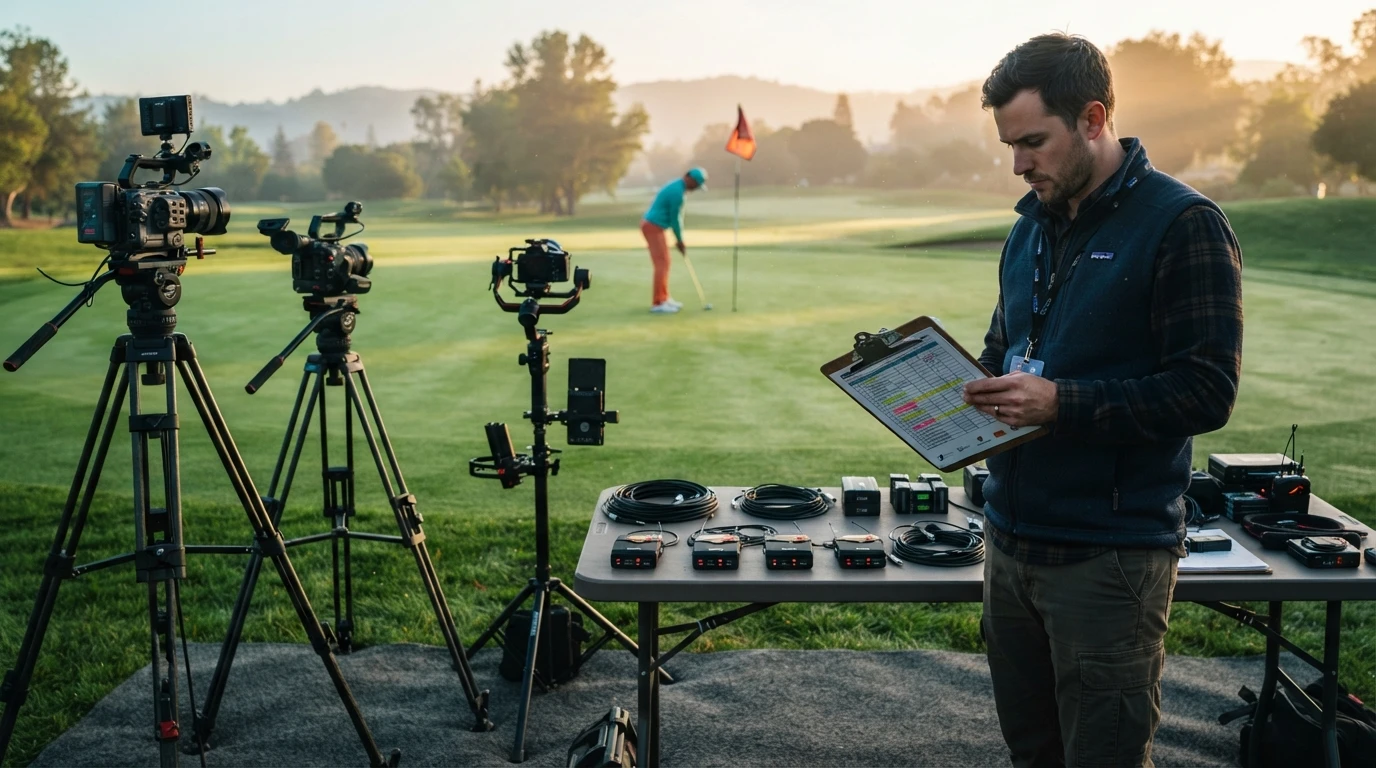
Event videography is the craft of capturing a live moment with enough intention, audio clarity, and brand discipline that it edits into a story people actually want to watch afterward. For corporate marketing teams and golf event organizers, that means you are not buying “coverage” – you are buying a planned set of deliverables, a shoot-day system, and a post-production workflow that turns one day into weeks of cinematic content.
Key Takeaways
- Ask for a deliverables list that includes formats (horizontal and vertical), runtimes, and audio standards before anyone steps on site.
- Use a run-of-show plus a shot list built around story beats (arrival, stakes, faces, payoff) so the day stays cinematic even when the schedule slips.
- Budget and crew size are driven by audio, multicam needs, and how many final edits you expect, not by how “big” the event feels.
Table of Contents
- What Is Event Videography, and What Deliverables Should You Expect?
- How Do You Plan a Shoot Day So the Story, Not Chaos, Wins?
- What Affects Event Videography Pricing and Crew Size?
- How Do Editing, Captioning, and Cuttowns Drive Engagement After the Event?
- Define Content Creator, UGC, and “Making Money” in the Event Context
- Frequently Asked Questions
What Is Event Videography, and What Deliverables Should You Expect?
Event videography is planned, professional video capture of a live experience, produced so it can be edited into specific outcomes: highlight reels, keynote coverage, sponsor recaps, documentary-style mini features, and social cutdowns that match brand guidelines. If a team cannot clearly define deliverables before filming, the edit will be a salvage operation.
For corporate event videography, the most common deliverables fall into a few lanes: a hero highlight (often called a sizzle edit), full-length program coverage (keynotes, panels, award moments), and a library of modular assets (short clips, b-roll selects, interview pulls) that marketing can deploy across LinkedIn, Instagram, YouTube, and internal comms. On golf properties, the “sports documentaries” approach matters because the emotional hook is usually human: pressure, rhythm, camaraderie, and the small moments between swings that make the day feel premium.
A clean way to align expectations is to request deliverables in a table that forces clarity on runtime, aspect ratio, and purpose:
If you want the deliverables to feel “on-brand,” insist on two things early: audio capture standards (lavaliers for key speakers, a board feed when available, and backup recording) and motion graphics rules (lower thirds, logo placement, and typography that respects brand guidelines). Even a stunning shot falls flat when the speech is muffled or the name titles look like an afterthought.
When you need inspiration for what cinematic golf storytelling can look like in practice, our Featured Media Posts gallery shows the difference between raw coverage and intentional, lifestyle-forward capture: https://ssodentertainment.com/blog-posts/
External reference that helps align terminology: Adobe’s overview of post-production roles and workflow is a solid baseline for non-video teams who want to understand what “editing” really includes in a professional pipeline: https://www.adobe.com/creativecloud/video/discover/video-production.html
How Do You Plan a Shoot Day So the Story, Not Chaos, Wins?
How you plan a shoot day determines whether your edit feels like a narrative or a slideshow. The goal is simple: lock the story beats first, then build logistics around them, because the schedule will shift and you still need the spine of the film.
Start with a run-of-show that includes more than times. It needs locations, who is on-camera, audio requirements, and what “success” looks like for each segment. On a corporate golf event, the highest-value beats are predictable: arrivals and registration, sponsor moments, warm-up range energy, a few marquee swings, short interviews that surface stakes, and a closing beat that feels like payoff.
A practical shoot-day system that keeps teams calm is built around three capture lanes:
- A-Roll (story): interviews, key quotes, awards, the moments where someone says what the event means.
- B-Roll (cinema): hands on clubs, shoes on grass, signage, reactions, crowd texture, venue details, and the in-between.
- Proof (coverage): the must-not-miss moments, captured safely with stable framing and clean audio.
That is the difference between “run-and-gun filming” that looks frantic and a controlled run-and-gun approach that still feels cinematic. It also determines crew roles. A single operator can capture beauty, but a single operator cannot be in two places when the keynote starts early while a sponsor photo op happens outside.
Audio is the silent killer of event footage. If you want story, you need intelligible voices. The National Association of Broadcasters has long treated quality audio as a foundational standard in professional acquisition and broadcast workflows, and the same reality applies to brand events: viewers will tolerate imperfect visuals longer than they will tolerate bad sound. A helpful primer for teams who want to understand the basics of production audio is Shure’s educational content on microphones and wireless systems: https://www.shure.com/en-US/performance-production/louder
If you are organizing a golf day, plan for wind and distance. A lav mic on the right person beats any “hope the camera mic gets it” approach, especially near greens where crowd noise and carts compete with speech.
For a feel of how a golf narrative can be structured around pressure and pacing, the Breaking 80 series format is a useful reference point for story beats and momentum: https://ssodentertainment.com/2025/04/25/breaking-80-ssodstyles-miami-shores-golf-club-would-need-a-late-surge-after-bogeys-on-back-to-back-holes/
What Affects Event Videography Pricing and Crew Size?
Event videography pricing is driven by complexity, not just hours on site. A half-day with multicam, two wired audio feeds, lighting for interviews, and a fast turnaround can cost more than a full day of simple b-roll capture, because the labor is in the setup and post-production.
Crew size typically grows for three reasons. First, multicam coverage: if you want a keynote with two angles plus clean audio and a locked-off safety, you are already beyond “one person with a gimbal.” Second, simultaneous moments: golf events often split across clubhouse, range, tee boxes, and sponsor activations. Third, deliverable volume: if you want a hero film plus ten social cutdowns plus a full keynote edit, the edit team has to be staffed accordingly.
A helpful way to think about scope before you request quotes is this table, which ties outcomes to resourcing:
If your team is trying to compare package options, Avello Brand Company’s services page lays out the named packages we build around cinematic capture, editing, captioning, and design concepts intended to elevate brand identity: https://ssodentertainment.com/club-styles/
You should also budget for the “unsexy” line items that protect quality: media management, backup drives, licensing for music, and time for stakeholder review. Music licensing is not optional if you are publishing commercially; platforms actively police rights. A straightforward overview of licensing realities for brands is available from YouTube’s own music policies and copyright education: https://support.google.com/youtube/answer/2797370
How Do Editing, Captioning, and Cuttowns Drive Engagement After the Event?
Editing is where event videography turns into marketing. A clean post-production workflow selects the right story moments, builds pacing, locks audio, applies color correction, adds motion graphics that match brand guidelines, and exports versions that fit each platform’s behavior.
For corporate teams, the highest-leverage deliverable is rarely the single hero film. It is the cutdown system. A strong edit suite can take one interview answer and version it into a 45-second LinkedIn thought-leadership clip, a 15-second vertical teaser, and a 6-second punch-in that works as an ad hook. That is what people mean when they talk about a “content creator machine”: a repeatable process that produces consistent outputs without reinventing the wheel every time.
Captioning is not cosmetic. It is distribution insurance. Many viewers watch with sound off, especially on mobile feeds, and captions also improve accessibility. The W3C’s Web Content Accessibility Guidelines (WCAG) treat captions as a key accessibility support for prerecorded audio content, which is why brands that care about compliance and inclusion build captions into the workflow rather than treating them as an afterthought: https://www.w3.org/WAI/standards-guidelines/wcag/
If you manage social, you already know the tool stack matters. Social media content creator tools that actually help on the brand side are the ones that reduce friction: frame guides for safe areas, templates for lower thirds, a review platform that supports timecoded comments, and an asset library with clear naming so your team can find “Sponsor A vertical 15s” in seconds.
This is also where the “content creator definition” gets practical for marketing teams. A content creator is not just a person who posts. A content creator is someone who can consistently produce, package, and publish media that matches a platform’s native format and a brand’s identity. If you are building internally, our guide on how to be a content creator covers the real blueprint teams use to go from scattered posting to a repeatable workflow: https://ssodentertainment.com/how-to-become-a-content-creator-a-real-blueprint
For golf, documentary-style edits outperform generic montages when you let the viewer feel tension and release: a missed putt, a recovery shot, a reaction, a quick interview line that reframes the moment. That is the DNA of the best sports documentaries, and you can borrow the structure without needing a Netflix budget.
Define Content Creator, UGC, and “Making Money” in the Event Context
Define content creator in an event setting as a role that bridges production and distribution: capturing with the edit in mind, then delivering assets that can be posted, repurposed, and measured. Teams often confuse this with “someone who films,” which is how you end up with hard drives full of clips and nothing that fits your calendar.
What is a UGC content creator, and does it replace professional coverage? A UGC creator is typically a person producing user-generated style content that feels native to social feeds, often shot on a phone, often quickly, sometimes as part of a paid arrangement. UGC can be useful for authenticity and volume, but it will not replace professional audio capture, multicam keynote coverage, or a cinematic brand film that needs controlled color, motion graphics, and clean licensing.
How to make money as a content creator shows up here because many brands now sponsor creators at events, especially in golf lifestyle circles. If you bring creators on site, treat them as a separate lane from your core event videography: set usage rights in writing, define what they will post, and make sure their footage complements your brand story rather than competing with it.
A quick reality check that saves headaches: if your leadership expects a polished hero film, you still need a professional production team and post pipeline, even if creators are present. Creators can amplify the moment; they are not your archival record, and they are not your brand film department.
If you want to see how lifestyle-forward golf storytelling can be packaged as a feature format, explore this example of a cinematic narrative post: https://ssodentertainment.com/2025/06/15/feature-birthday-edition-of-breaking-80-adds-value-to-years-of-rounds-booked-at-the-nash/
Frequently Asked Questions
What is the difference between videography and video production?
Videography usually refers to capturing and editing video with a smaller crew and a tighter scope, often for events and fast-turn content. Video production is broader, often including pre-production planning, larger crews, sets, and more complex post such as motion graphics and sound mixing.
What are the different types of videography?
Common types include event videography, corporate brand films, wedding and lifestyle, documentary, commercial production, and social-first vertical content. The practical difference is the mix of planning, audio needs, and post-production polish expected.
What is a reasonable budget for videography?
A reasonable budget depends on deliverables, audio requirements, crew size, and turnaround time. If you want multicam keynote coverage plus a hero edit and multiple social cutdowns, expect the budget to be driven more by post-production hours than by filming time.
What are the basics of video production?
Basics include pre-production planning (run-of-show, shot list, brand guidelines), production (camera, lighting as needed, and reliable audio capture), and post-production (editing, sound, color, graphics, captions, and exports for each platform).
If your next event needs to feel like a premium sports moment rather than raw coverage, build your scope around story beats, audio, and deliverables first, then hire a team that can execute with discipline on site and precision in post. When you are ready to map a cinematic plan for your tournament, keynote, or brand activation, reach out through Availability to start the conversation: https://ssodentertainment.com/contact/


Leave a Reply