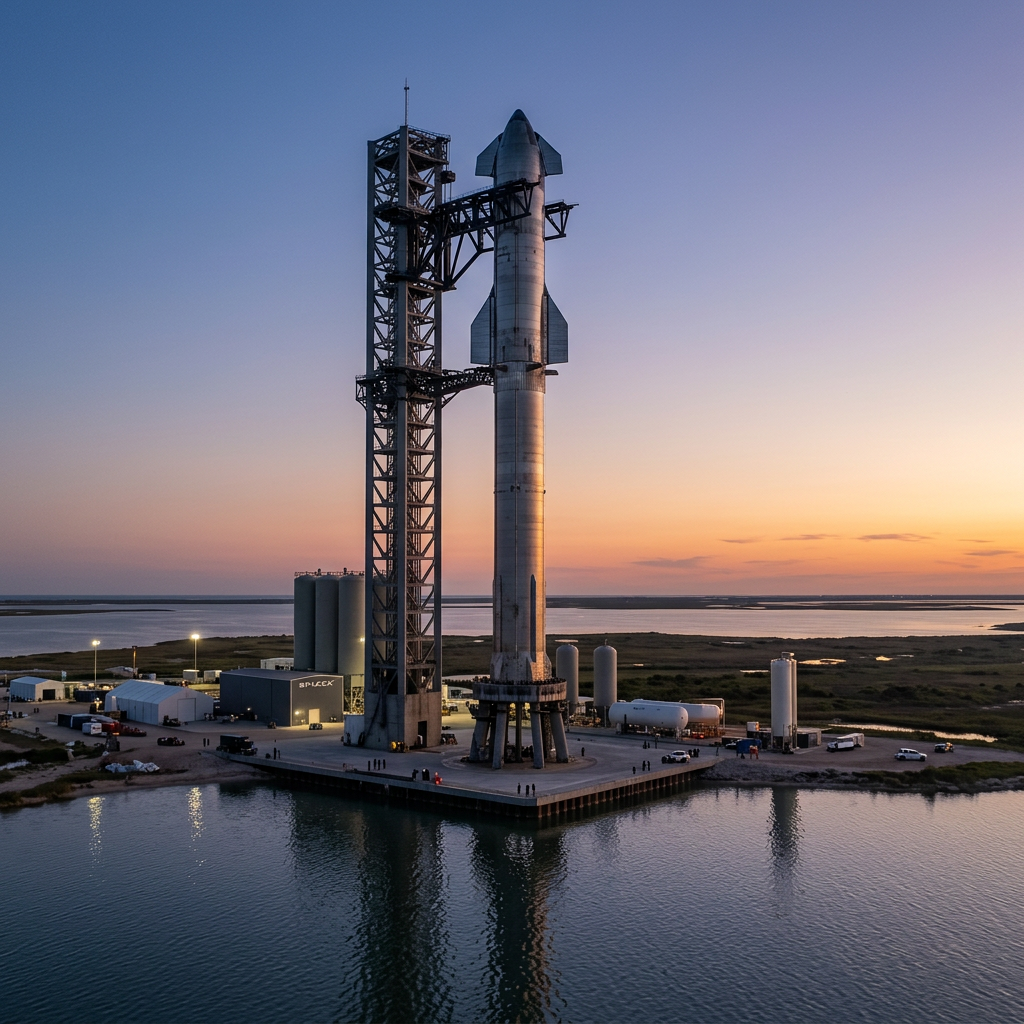
Redefining the Horizon : Inside SpaceX’s Historic Starship Flight 12
Powered by 33 of SpaceX’s Raptor-class engines and executing a complex procedure called a partial boostback burn, Starship—SpaceX’s massive, next-generation spacecraft—recently completed its historic Flight 12 test. Leaving a wall of fire and steam in its wake at Starbase, Texas, this mission pushed the boundaries of what a reusable spaceflight architecture can achieve.

This wasn’t just another routine launch. Flight 12 marks the twelfth integrated flight test of the system since April 2023, and it functions as a critical turning point for commercial aerospace. If you have been following the evolution of modern rocketry, this flight offered a front-row seat to the future.
Brand New Hardware, Brand New Pad
At a staggering 408 feet (124 meters) tall, the vehicle flown during Flight 12 is the largest and most powerful rocket variant SpaceX has ever successfully launched. This mission served as the official maiden voyage of Starship Version 3 (V3), featuring a comprehensive design overhaul from previous models.
The main objective of the flight was simple yet daring: validate entirely new pieces of hardware in a live flight environment. To support a much faster launch cadence, the vehicle lifted off from a completely new launch pad, Orbital Launch Pad 2 (OLP-2), built to withstand the intense thermal forces of the upgraded Raptor 3 engines.
While the primary goal was data collection, the mission delivered a spectacular cross-global show. After a successful hot-staging separation, the Super Heavy booster attempted a partial boostback burn. Despite encountering off-nominal engine behavior that caused it to miss its intended “virtual tower” soft splashdown in the Gulf of Mexico, the upper Starship stage pushed onward.
Cruising at an altitude of nearly 120 miles, Starship deployed 22 Starlink mass simulators and successfully tested critical reentry dynamics before a nominal, controlled splashdown halfway around the world in the Indian Ocean.
Disruption or Collaboration? The NASA Dynamic
A question frequently asked by onlookers is whether SpaceX’s rapid, highly publicized development cycle is actively penetrating—and perhaps displacing—a spaceflight industry dominated by NASA for decades.
To view this as a zero-sum corporate war is to miss the larger picture. For the better part of a century, NASA functioned as the primary architect, owner, and operator of American spacecraft. Today, the agency has intentionally shifted toward a model where it acts as a primary customer and partner to the commercial sector.
The Lunar Connection: NASA isn’t being pushed out; they are actively funding this evolution. NASA selected Starship as the Human Landing System (HLS) for the upcoming Artemis III and IV crewed lunar missions.
Every milestone SpaceX hits with Starship directly accelerates NASA’s timeline to put boots back on the Moon. It isn’t a story of hostile domination, but rather a radical evolution in how public infrastructure and private agility intersect.
Reusability: A Win for All Humanity?
The massive scale of Starship opens up a larger ethical debate about the nature of modern space travel: Are uncrewed test flights enabling a hyper-competitive billionaire space race, or are they driving development that benefits all of humanity?
The answer lies in the economics of mass. For decades, space travel has been restricted by an unforgiving financial bottleneck—the extreme cost per kilogram required to break free of Earth’s gravity. By dedicating these early, uncrewed missions to mastering full, rapid reusability, SpaceX is systematically driving down those costs.
When getting to space becomes affordable and routine, the benefits ripple far beyond a single company’s balance sheet. It opens the door for global universities to launch climate-monitoring satellites, allows international research teams to conduct deep-space astrophysics, and builds the foundational logistics required to establish a permanent human footprint on Mars.
Flight 12 proved that the path to the stars is paved with iterative failures, charred heat tiles, and relentless innovation. As the V3 platform matures, we are witnessing the construction of a transportation network that will inevitably belong to the entire world.


Leave a Reply